
If you love cycling, you already know it’s good for your heart, your mood, and your waistline. But did you know that a specific kind of cycling—done at just the right intensity—can actually slow down aging at the cellular level? It’s called Zone 2 training, and it might just be the closest thing we have to a fountain of youth on two wheels. And yes, we know Zone 2 has been making headlines recently all over the internet. But we thought it was time to write a post that cuts through all the hype and gets down to the science of why Zone 2 is such a great choice for most average cyclists. Spoiler: it is NOT just about weight loss!
Forget the “no pain, no gain” mindset. The best ride for long-term health isn’t your hardest—it’s your most consistent and metabolically smart.
What Is Zone 2 Training?
Zone 2 is a moderate-intensity effort where your body burns primarily fat for fuel. You’re not gasping for breath, you’re not sprinting—you’re cruising in a steady, aerobic state. This is where the magic happens for longevity.
Zone 2 cycling boosts your mitochondrial efficiency, improves insulin sensitivity, and reduces oxidative stress—all key markers of biological aging. It’s like tuning up the engine of your body instead of revving it to the redline.

 Those long, slow, flat rides in Zone 2 are the way to go
Why Cyclists Should Care
Here’s why Zone 2 rides are perfect for everyday cyclists:
- They don’t wreck your body like high-intensity sprints.
- They’re easy to recover from, so you can ride more often. Always a huge plus for those of us who are addicted to cycling!
- They improve your ability to ride longer and stronger over time.
- And they actually help you live longer by optimizing your health at the cellular level. And a longer life means more bike rides, right?
Even better? They’re fun! Zone 2 rides are the ones where you feel good, enjoy the scenery, and maybe even sing along to your playlist—if you’re not pushing too hard.
What Zone 2 Does Inside Your Body
Let’s break it down:
- Zone 2 burns fat efficiently by improving how your mitochondria use fuel.
- Zone 2 boosts heart health by improving your heart’s ability to pump blood at low intensities.
- Zone 2 improves metabolic health by enhancing insulin sensitivity.
- Zone 2 activates longevity pathways like telomerase (which protects your DNA) and antioxidant production (which fights cellular stress).
- Zone 2 helps your body repair itself without overwhelming it like intense training sometimes can.
Think of it as the “maintenance crew” that keeps your system running smoothly every day—versus the “emergency repair squad” that comes out when you push yourself too hard, too often.
Your Body Is a Hybrid Engine
Your body can run on two types of fuel: carbs (like gas) or fat (like electricity). Most of us spend too much time burning carbs—especially if we’re constantly going hard. But Zone 2 teaches your body to run efficiently on fat, which is cleaner, more stable, and easier to sustain.
It’s like switching your body from a gas-guzzling pickup to a sleek, long-range hybrid. Now, I would never say that I personally am sleek. But I can say that during my weight loss journey based on low carbs, I finally taught my body how to run on fat. That was three years ago, and my body continues to be an efficient hybrid-type vehicle. With the result that I am keeping the weight off, simply by continuing to ride my bike most days.

 The photo on the left is me before weight loss, and the one on the right is me after losing weight and maintaining my weight loss for three years. During that weight loss journey, my body finally learned how to run on fat. It had no choice, because I kept my carbs low, while keeping my bike rides long. It took thousands of miles in Zone 2 to do this!
How to Know If You’re in Zone 2
I found this was the hardest part to figure out. I finally realized it was because I am so fit from years of cycling, that what I thought was Zone 2, based on my heart beat, was in fact very low Zone 1 for me. The default formula for calculating your maximum heart beat does not work if you are fitter than average. And if you figure out all your zones from that maximum heart beat, then all of your zones will be incorrect.
That said, there are a few ways to correctly figure out your own personal Zone 2, depending on your gear and preferences:
Method 1: Heart Rate Method (Most Practical)
- First, find your true max heart rate—not just “220 minus age.”
- Ideally, get a stress test or do a max effort test with a coach or wearable.
- Zone 2 = 60–70% of your max heart rate.
Example: If your true max HR is 180, your Zone 2 is roughly 108–126 bpm.
Method 2: Power-Based Training
- Use your cycling power meter (Garmin, Wahoo, etc.).
- Do a 20-minute FTP test to determine your Functional Threshold Power.
- Zone 2 = 55–75% of FTP.
Example: FTP is 200 watts? Your Zone 2 range is 110–150 watts.
Method 3: Use Zwift
If you use Zwift, there is an easy way to check your FTP. It’s not fun, but it is easy to do!
Go to “Workouts”
From the main menu, click “Workouts” (bottom left)
Choose “FTP Tests”
Select “FTP Test (Short)” – it’s about 45 minutes total.
- Note: If you are a beginners, an older cyclist, or you find 20 minutes all-out intimidating, choose FTP Test (Ramp). This is much shorter, but it does end with short, all-out efforts.
The tests include a built-in warmup with short efforts to get your legs ready.
If you are doing the Ramp test, you will pedal through short 1-minute steps, each one getting slightly harder, until you can’t go anymore. Zwift then estimates your FTP based on your final step
If you are doing the Short test, You’ll ride as hard as you can sustain for 20 minutes. Try to pace yourself—don’t go all out at the start. Aim to hold a strong, steady effort. Your average power over this 20 minutes is used to estimate your FTP.
After the tests, Zwift guides you through a cooldown.
At the end, Zwift will calculate your FTP and update your training zones automatically. It will also tell you your score.
- There is also a choice called FTP Tests (Long) but this is intended for experienced riders or data nerds who want max accuracy.
Pro Tip – An Even Easier Method in Zwift and Rouvy
If you don’t want to do a test, you will notice that Zwift estimates your FTP anyway, based on how you ride. Rouvy does the same thing. But be careful, because the default on Rouvy is that it starts off with a wild guess. You have to tell it to calculate. When I did that, my FTP halved, which was humbling, to say the least. In any event, once you have an FTP, say it is 200. If you then ride at 110 to 150 watts (55 to 75%), you are most likely riding in Zone 2. You can check this by seeing if you can still sing at 150 watts!
Method 4: Talk Test (Super Easy)
- You should be able to speak in full sentences but not sing.
- If you’re breathless, you’re going too hard.
- If you’re chatting effortlessly, you might be under.
- I occasionally use the Happy Birthday song to check if I am in Zone 2. It sounds goofy, especially as I am one of the few people in the world to ever be banned from using a karaoke machine, but it works!
Common Mistakes to Avoid
- Thinking it’s just for fat loss: Zone 2 isn’t just about burning calories—it’s about building metabolic flexibility.
- Relying on formulas only: Generic heart rate calculators are sometimes way off. Test if you can. When I tested, I found that my real max HR was 44 beats higher than the one I got when I did the standard calculation (220-your age). So if you feel like you could sing an opera, but you’re in Zone 5 based on your calculated max HR – then the calculation is wrong for you. This calculation is for average people. Anyone who has been cycling regularly for more than a year is no longer average.
- Going too hard: “Intensity creep” is real. Use a heart rate monitor or power meter to keep yourself honest.
- Don’t let your ego mess you up! Yes, it is very hard to be passed by people twice your age, but suck it up. Keep your eye on the end goal, which is beating that person by eventually getting ever older than they are!
Suggestion: personally, I find the easiest way to stay in Zone 2 is on a flat ride, preferably an indoor ride where I can keep an eagle eye on my watts and heart beat. And if I am going to be cycling in Zone 2 indoors, the easiest way is on the Rouvy app. Why? Because there are far fewer other real-life cyclists, so it is easier to keep my ego in check. On Zwift, other riders will constantly be zooming past you. Plus, if you have the Zwift Companion app handy, you can easily check the details of that cyclist who just passed you like you were standing still. And this might just provoke you to lose your head. “That woman who just passed me is 105 and belongs to the Triple Bypass Survivors Cycling Club? Hell no!” And the next thing you know, you’re in Zone 5 – but you have left that woman in the dust!
On Rouvy, you might not see another rider for the entire ride. Today I did the L´Etape Rio de Janeiro Sprint Route in Brazil. It’s 22 miles of completely flat terrain with interesting scenery, so it’s perfect for Zone 2. And there were only two other real riders – a man who never moved at all (coffee break?), and a woman who passed me so fast that I missed seeing her because I glanced at my phone. As a result, I am proud to say that I managed to stay in Zone 2 for 85% of the ride. By contrast, I have sometimes managed as little as 15% in Zone 2 on Zwift – just because I could not stand to be passed by so many other cyclists.

 A perfect Zone 2 ride on Rouvy. My heart beat was in Zone 2 for 85% of the time. Afterwards, I felt really good. Enough exercise to make me feel good and let me imagine I could feel my mitochondria growing – but not enough to be tired
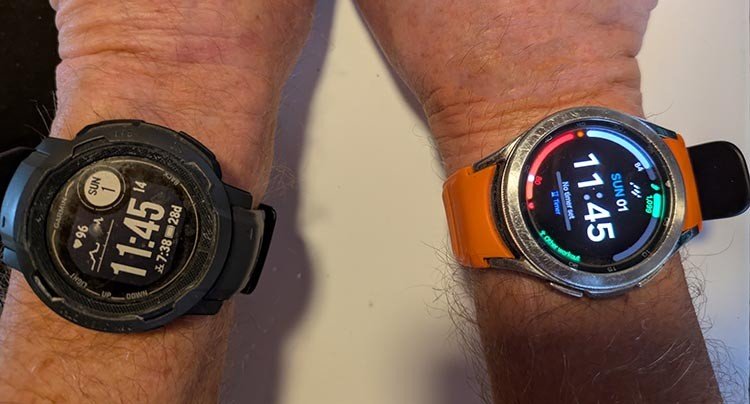
- Use an accurate watch or heart rate monitor to monitor your progress. Every time I get a new watch, I test it against my old watch, and against my Wahoo chest heart rate monitor. Till now, I have been pleasantly surprised by the accuracy of my watches. But then, I don’t buy $25 watches. I only use Samsung (in the past) or Garmin (now). Since I got my new Garmin Instinct watch (the one on the left), I have continued wearing my Samsung Galaxy watch, so that I can compare accuracy. So far, I have been amazed at how much they are in perfect agreement. The difference, of course, is that Garmin collects way more data, and gives it all to you. Oh, and the other vital difference – the Garmin battery lasts for a month, and the Samsung lasts for a day. And the Garmin gives you your HRV (Heart Rate Variability) any time you want, while the Samsung only tells you what your HRV was when you were sleeping. See our post: Best Smart Watch to Monitor Your HRV: Garmin vs Fitbit vs Apple vs Samsung.

Related Post: Garmin HRM Dual vs Wahoo TRACKR Heart Rate Monitors: The Ultimate Heart Rate Monitor Showdown for Cyclists
How to Start Zone 2 Cycling
You don’t need to overhaul your entire training plan. Just start here:
The 3–3–30 Rule:
- 3 rides per week
- 30 minutes per ride (build up when you can.
- Stay strictly in Zone 2
️ Build Gradually:
- Weeks 1–2: 15–20 min
- Weeks 3–4: 20–30 min
- Weeks 5–6: 30–45 min
- Eventually: up to 60–90 min for deeper adaptation.
- The sky is the limit! I am aiming for 3-hour rides, so that I can eat a lot of chocolate).
Recovery Matters

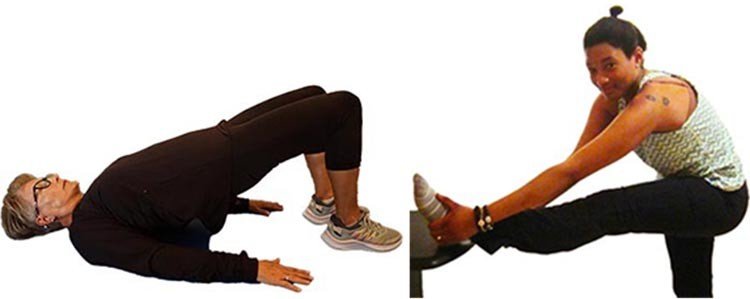
Even though Zone 2 feels easy, it still taxes your system. Prioritize stretching, sleep, recovery, and good nutrition. Use a heart rate monitor to track HR accurately and avoid overtraining. Or a decent fitness tracker.
Related Post: What is HRV, Why Should I Care, and How Can I Measure It?
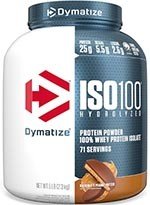
Personally, even after all these years of cycling, I find a very long bike ride leaves me with tired legs, and in need of a very long sleep that night. I always take protein powder about an hour before bed to help my body to recover and improve as I sleep.
 |  |
 |  |
How to Track Progress
Keep a Zone 2 journal for a month. Log:
- Time spent in Zone 2
- Heart rate or power data
- How you felt (energy, mood, sleep)
- Resting heart rate and HRV (if you track them)
Over time, your pace or power at the same heart rate should improve. That’s a big win.
Bonus: Want to Geek Out?
If you love the science, here are some lab-tested Zone 2 benefits:
- Improved Heart Rate Variability (HRV) — a measure of how well your body handles stress and recovery. See our post on why HRV matters.
- More efficient mitochondria — like upgrading your cells from economy to first class.
- Antioxidant boost — from activating the Nrf2 pathway, which boosts your body’s natural defenses.
- Telomere protection — keeping your DNA “end caps” longer, which is linked to slower aging.
- DNA repair — more efficient repair of everyday oxidative stress damage.
- Cardiac remodeling — your heart adapts to become more efficient at pumping blood during low-intensity efforts. This is the one that excites me the most. In my fight against aging, I am trying to do everything I can to keep my engine (my heart) going strong.
Bonus Tip: Don’t Ignore the Environment
- Hot day? Your heart rate may be 10 bpm higher than usual for the same effort.
- Hilly ride? Consider power-based pacing or just use the talk test to keep intensity in check.
- Low sleep or sick? Take it easier—Zone 2 is still great for recovery days.
- If you can do indoor training, then it is easier to get all the variables consistent. See our posts on indoor cycling.
Final Takeaways
Zone 2 training is accessible, sustainable, and incredibly powerful for long-term health and cycling performance. It might not be the sexiest ride on your Strava feed—but it’s the one that keeps you riding for years to come.
So grab your bike, dial in your effort, and enjoy the ride—not just for today, but for a very long lifetime.

Leave a Reply